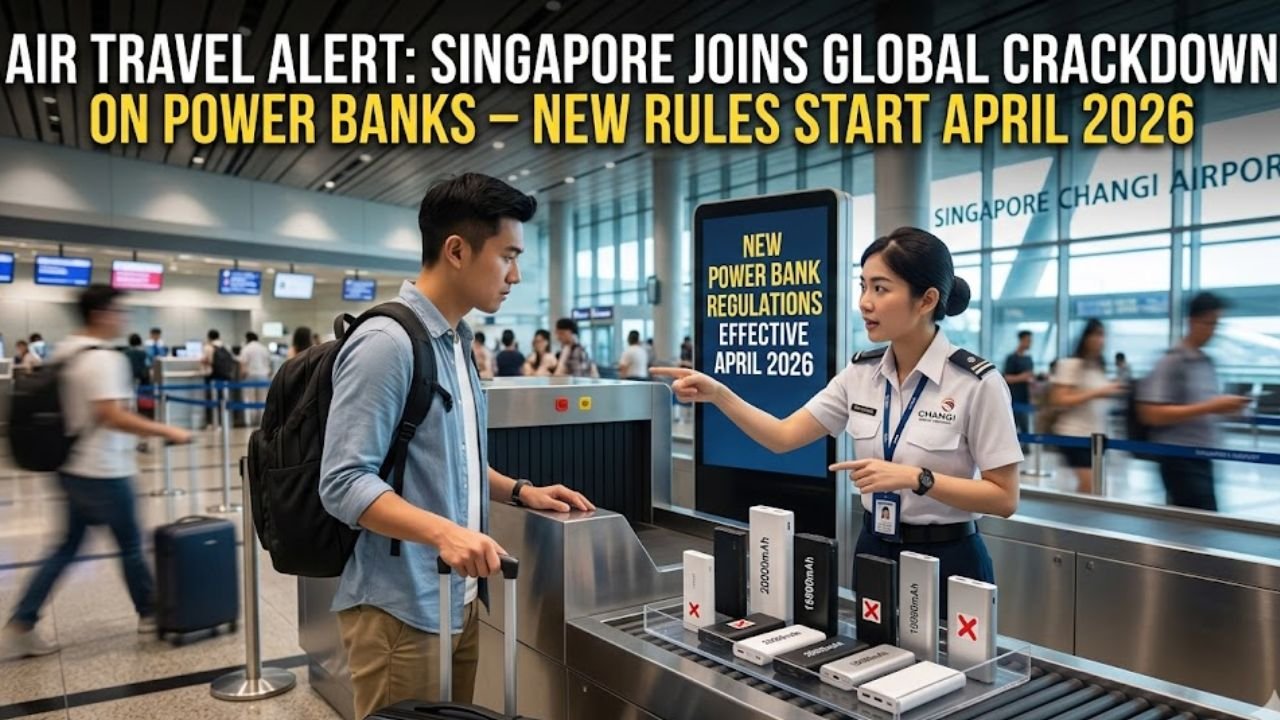
The aviation industry is changing rapidly. From April 15 2026, all travel from Changi Airport in Singapore will receive additional restrictions regarding travel with power banks. This decision has come from the Singaporean government. This is in response to the International Civil Aviation Organization (ICAO) implementing restrictions regarding travel with lithium ion devices. There have been many problems with power banks exploding on (or in) airplanes, which is why they are now going to be treated as serious travel accessories. Passengers will now be limited to two power banks, which are to be kept with them on the plane (cabin baggage). If during security screening, excess power banks are discovered, they will be disposed. This is to prevent charging devices to have no possessional limits.
Safety Measures and New In-Flight Limitations
These guidelines focus on eliminating emergency risks to fire from batteries in the cabin. In addition to the firm numerical cap, CAAS and most airlines such as Singapore Airlines have completely banned the charging and use of power banks on flights. This means that you may only bring your two devices on the plane, but they cannot be in use. The cables and ports offerings of aircraft systems are not to be used to charge the power bank or charge your phone or laptop. This measure tries to remove the battery charging stress, from which most devices cause overheating. Power banks must now be carried in cabin bag pockets, and not stowed away in compartments, so if a device starts to cue the cabin crew to take action before it escalates the situation.
Capacity Limits and Global Regulations
While recently introduced quantity limits present an additional challenge, specific battery capacity-related requirements are heavily enforced, and legally defendable. Regulators draw a line between ordinary consumer products and batteries for professional use. Most power banks are battery packs that fall below a 100 Watt-hour (Wh) limit. As long as they comply with a 2-device limit, they can be transported without additional approval. But, larger power banks used by digital nomads and photographers require airline approval. Of note, power banks over 160Wh are banned on all commercial passenger flights. Below is a table outlining some of the 2026 standards that will help you identify which power banks will be allowed on flights:
| Power Bank Capacity | Approval Required? | Carry-On Permitted? | Checked Bags? |
| Under 100 Wh | No | Yes (Max 2 units) | Strictly Forbidden |
| 100 Wh to 160 Wh | Yes (Airline Consent) | Yes (Max 2 units) | Strictly Forbidden |
| Over 160 Wh | No (Prohibited) | No | No |
| Damaged/Recalled | No (Prohibited) | No | No |
Harmonised Improvements to Global Aviation Security
Singapore is the first of many to have developed cross-regional legislation. Updates for 2026 are being developed with a clear vision to unify the International Air Transport Association (IATA) and several of its continental subsidiaries. Lufthansa Group, Qantas, and a number of major Japanese carriers have already included “no-charge” practices in their safety announcements earlier this year.
A decade of data shows that lithium battery incidents on planes are increasing, most of which are due to low-quality or fake power banks that have no thermal management systems. Because of this, some countries have restricted the use of electronic devices that are turned on during flights, and also limited the quantity of such devices carried on board to reduce the ‘fire load’ potential within the passenger cabin. All travelers, especially those transiting major airports in Asia, Europe, and North America, should expect the most stringent implementation of these regulations as battery power density scanners have been re-set to detect power banks more accurately.
Rules You Should Follow When Traveling
All travelers should expect to be impacted by these new rules. They should take proactive steps to customize their electronic devices. To comply with the new regulations, fully charge your smart devices before you arrive at the airport. Because use of power bank devices is no longer allowed on the plane and the built-in power outlets are also illegal to use to charge your device, you are the legally allowed device on some intercontinental flights. Any device that meets this standard should be holstered. Rule of thumb, check your power bank for a ‘Wh’ rating that is fully printed. If it is not, security personnel in strict countries, like Singapore, can confiscate this device. Legitimate brand name chargers and power banks that are UN38.3 standard compliant are extremely critical for travelers wanting to clear security without delays.
FAQs
Q1 Can I pack my power bank in my checked bag?
No. Power banks are not allowed in checked bags because of the possibility of a fire hazard that is known as a thermal runaway. They have to be carried in your hand luggage.
Q2 How do I determine if a power bank is less than 100 Wh?
Most of the 20,000mAh power banks are around 74Wh. You can estimate this by multiplying the mAh by the voltage and then dividing that by 1000.
Q3 If I have 3 power banks, will I face consequences at Changi Airport?
As of the rules that are effective as of April 15, 2026, You will have to throw away the additional device at the security check before you are allowed to move to your gate.