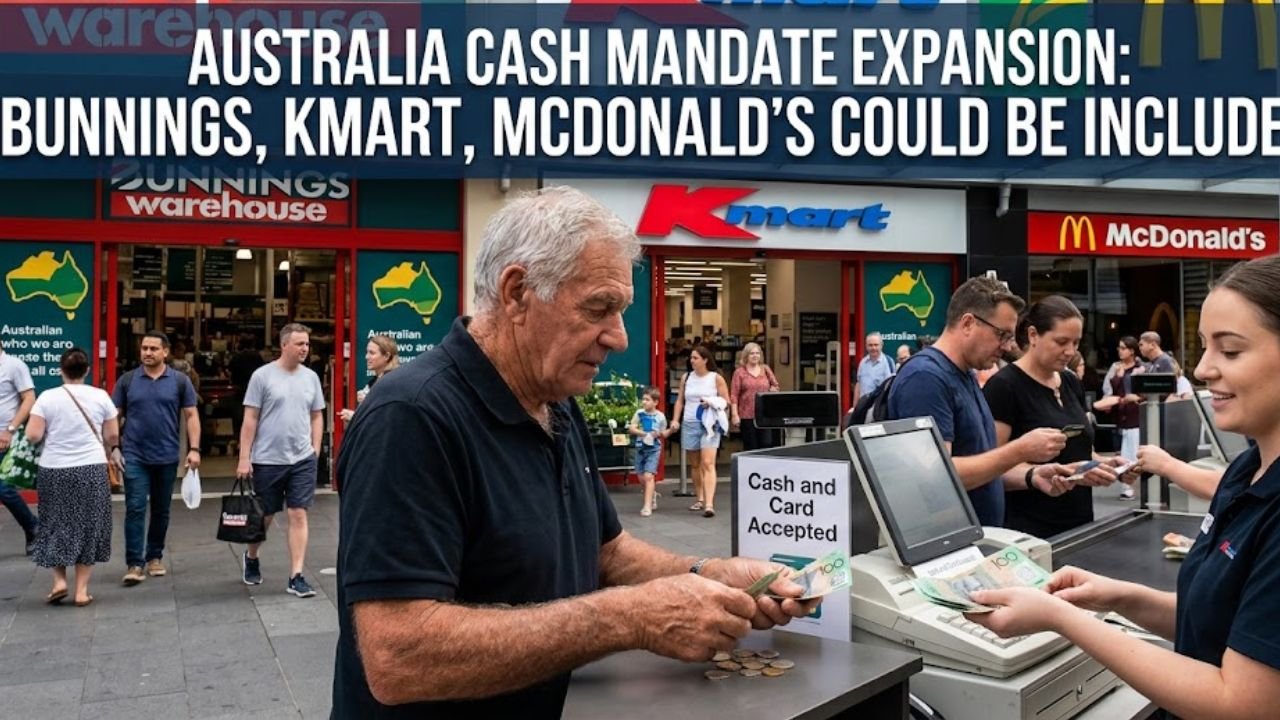
Offering nothing but digital payment options for stores has become extremely popular over the last few years across many countries, including Australia. However, the government has decided to put a stop to this trend. Starting January 1, 2026, the Australian government is implementing a cash mandate, meaning that people will be able to spend their cash at major retailers for everyday needs. Initially, cash acceptance was expected to be limited to grocery stores and gas stations. Some people even think that retailers like McDonald’s, Kmart, and Bunnings should be included. This policy has been put in place to make sure that people are not digitally excluded from society. There are also concerns that the digital systems are not sufficiently robust, and people will be at a loss if a natural disaster occurs. Everyone should be able to make transactions using legal tender. The elderly and people who live in the rural areas have been the most significantly affected by the new policy and cashless trend.
Where the Mandates Expand Outside of Grocery Items
In this case, the principle of the 2026 mandate remains unchanged concerning the protection of “essential” commerce, especially with regard to the selling of loafs of bread and petrol. Throughout the course of Treasury consultations, ‘essential’ became associated with “limited” meaning and purpose. Take, for instance, a rural family. From their viewpoint, a Bunnings hardware store becomes essential for emergency DIY home repair jobs. Without it, we would not have access to the American-style ‘big-box’ Kmart retailer, which also comes to the rescue in the vicinity with affordably priced clothing and everyday household items. Even in the event of a telecom outage—a phenomenon the Australian bushfire and flood seasons disturb with a frequent regularity— and despite the fact that life-sustaining supplies are purchased at the hardware store, the other shop un-beggars the telecom outage. Likewise, the closure of quick-service restaurants, including the world-famous trademark of McDonald’s, doesn’t spare the low-income worker or the student who seeks a cheap meal. The purpose of the widening of the set of supplies is to mandate that, in the case of an economically disempowering event, the vast part of the society’s safety net remains intact. In this regard, it is anticipated that society’s older population will possess the facility and dexterity to fulfill this-degree-of-freedom, which in many ways is in the vicinity of their remote service. This is to say when shopping with a smart shopping cart in a sensor-equipped supermarket, it will be relatively easy to bypass the self-checkout that consists of a touchless, self-service kiosk. In this case, a sensor-compatible cart would be able to minimize or preclude the sensory input (to the cart) of the individual use of the multiple grocery items.
Important Features of the 2026 Cash Acceptance Policy
In simple terms, all policies that designated a purpose for transactions have since begun outlining other parameters as part of their policies, which in the end, do not set policies in their own right. With concerns of entrepreneurial activity, there comes a lightening of the relatively larger business enterprises as far as their annual cash flow is concerned, more precisely and less so with regard to the small family business enterprises that, despite the small volumetric nature of cash, are still brought to bear at the expense of larger, more widely distributed cash enterprises. As such, larger business enterprises that, in terms of cash flow, remain uninhibited financially, can be larger and, in relative terms, smaller family-oriented units that are not cash-oriented, along with their limitations. This may be far removed as far as in-person transactions and cash flows are concerned, which, in the case of electronic transactions, are intact and self-limited, as far as everyday spending goes.
| Feature | Regulation Detail |
| Start Date | January 1, 2026 |
| Transaction Limit | Mandatory acceptance up to $500 |
| Exempted Businesses | Annual turnover under $10 million |
| Operational Hours | Mandatory between 7:00 AM and 9:00 PM |
| Primary Categories | Fuel, Groceries, and Essential Retail |
Balancing Innovation with Inclusivity
As 2025 drew to a close, the momentum regarding the right to pay with cash and to not become a completely cashless society began to shift once again legislatively. Opponents to digitization claim it is a cashless society, an argument where a stable internet and power allows people to fully utilize an efficient system. This is something that Australia has highlighted due to its emergency scenarios where the infrastructure could no longer sustain load. By mandating cash retention to large retailers (i.e., Kmart, Bunnings), the government is providing ‘payment redundancy’ to the economy as the interconnected zero-cash society is highly vulnerable. Additionally, the E-E-A-T (Experience, Expertise, Authoritativeness, and Trustworthiness) standards applied to this policy change is focused on cash providing the privacy and autonomy that a person is entitled to. Cash allows people to control their discretionary spending without an expenditure tracker that harvests the data, an assertion that people do not want in a free cash society.
Changes to Big Shopping Chains
Major companies such as Bunnings and McDonald’s will have to completely change their digital-focused strategies that they have been building for years. Many had moved to card-only self-checkout terminals to reduce employee costs and to minimize the risk of theft. Now these companies will have to re-spend on staff training and cash handling equipment and services that are secure, such as Armaguard. This may complicate operations, but it provides a new opportunity for a more neglected demographic. Retail survey data for 2025 suggested that a small, but non-negligible, number of people felt “alienated” by card-only signs. These companies have been losing customers, as now, by taking cash, they are no longer breaking the law but providing the opposite of a card-only sign. To ensure Universal Service, the cash law will be reviewed again in 2029 to decide whether the cash limit of $500 and the turnover threshold of $10 million still fit the world as we know it.
Forecasting Changes to Payments in Australia
By 2026, the Great Cash Comeback will likely inspire similar movements in Public Transport and Healthcare, and the Australian Government reinforces the position, while the future is visibly Digital, the bedrock has to be Physical. This hybrid model assures that the modern-day convenience is without the sacrifice of fundamental needs. The breadth of the new legislation will be technological advancement for professionals, and at the same time, preserving wallet cash, and legally holding the balance and preserving money for the necessities of your most privileged needs for all of your distinguished, unremitting, and endearing needs. The legislation’s extension to Kmart, Bunnings, and McDonald’s, signifies the final closure of the era dubbed cashless by stealth, and the commencement of the new, and more together, and more to come for the future of the Australian nation.
FAQs
Q1 A store can still say no to cash for a $600 purchase.
Yes. The current regulation only mandates cash acceptance for in-person transactions of $500 or less. Above this amount, electronic payment is allowed, and stores can still request for that.
Q2 Will the new law make local cafes legally have to take cash?
Not, and particularly no. Small businesses with annual revenues of less than $10 million, that legally say no to cash, are allowed with less than legally no cash.
Q3 Will this mandate cover online purchases?
No. The 2026 cash mandate only applies to direct, in-person, ‘bricks-and-mortar’ interactions where the buyer and the products are present at the time of the transaction.