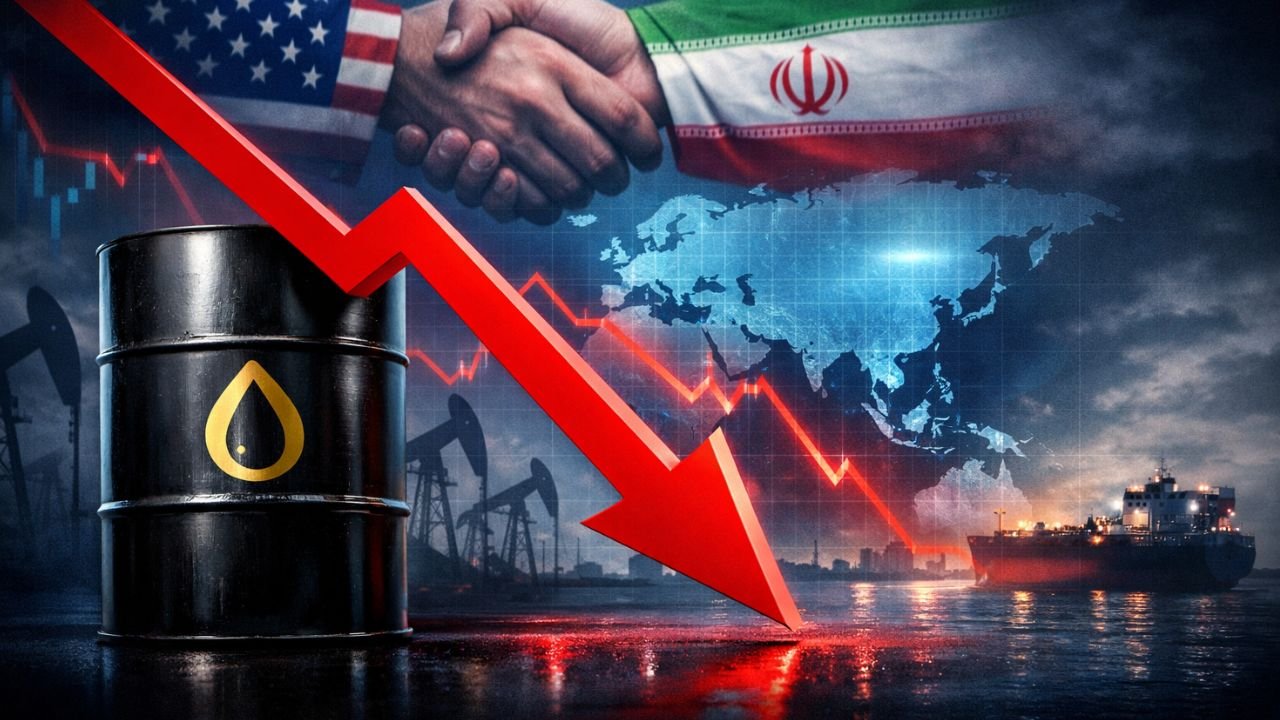
After a seismic shift in the global energy landscape, crude oil prices have fallen after the United States and Iran have announced a two-week ceasefire agreement. In addition to the ceasefire, the reopening of the Strait of Hormuz has been a major source of relief. WTI and Brent crude oil prices have fallen by * * * and * * * percent, respectively. The diplomatic breakthrough has allowed the first real relief to a previously unsettled and agitated market, and led to a precipitous drop in oil prices that were previously pushing well above * * * / barrel and * * * / barrel. With oil prices previously skyrocketing, the ceasefire has provided consumers and industries the first real opportunity to stabilize their economic lives after years of devastation.
The Hormuz Strait and The Restoration of Global Supply
Arguably the single most important global supply transit point, the Strait of Hormuz is set to restore global energy supply. 20% of global supply of oil and a sizeable supply of liquefied natural gas (LNG) is transited through the Strait of Hormuz. During the most recent of conflicts, the crude strike of the Strait of Hormuz caused the single largest supply disruption to date, and created unprecedented disruptions to global supply chains. The fear of the bottleneck was the motivation for Brent crude prices reaching an unprecedented * * * per barrel earlier this year. With the newly announced agreement, it is anticipated that the bottleneck will be substantially reduced and will provide normalcy to the global supply once again.
Market Reaction and Economic Implications
The financial markets reacted quickly and predictably. In New York, London, and Tokyo, stock prices increased as energy prices began to fall. Jet fuel prices decrease and gave traveling companies a bright outlook, leading to airline stocks gaining over 10% in premarket trading. Relaxation on travel restrictions will likely cause a boost in travel demand. In contrast, top energy companies experienced a decrease in stock prices, a correction to the weeks of gains brought on by scarcitiy predictions. Though the temporary ceasefire will only last 14 days, the period of time has brought a stabilization to the U.S. dollar and a slight decrease in the inflation that was going to cause devastation to the world economy at the beginning of 2026.
Immediate Effects on Global Oil Benchmarks
The table below shows the direct effects of the announced ceasefire on the main energy benchmarks and their prices relative to the heights reached during the active conflict.
| Energy Benchmark | Conflict Peak (USD) | Post-Ceasefire Price (USD) | Percentage Change |
| Brent Crude | $120.40 | $93.73 | -22.1% |
| WTI (US Crude) | $112.95 | $94.52 | -16.3% |
| Natural Gas (Futures) | $4.20 | $3.99 | -5.0% |
| US Retail Gasoline | $4.15 | $3.85 (Est.) | -7.2% |
Strategic Reserves and Long-Term Stability
The two-week ceasefire is a positive sign, but energy experts predict there is little hope of keeping prices stable in the future. Earlier this year the IEA (International Energy Agency) released 400 million barrels of oil from their strategic stockpiles to provide a temporary solution, but there will come a time when these reserves need to be replenished. Most experts predict, this situation will be used as a case study to test how their diplomatic relations will develop in the future. If we are able to ship to and from the Strait of Hormuz and there are no hiccups along the way, we may be able to draft a Treaty of Peace and Friendship that will also address the temporary nuclear and regional security concerns. If there is no further extension after the first set of deadlines passes, the market will be left hoping we can avoid the peak volatility again. The structural damage in regional facilities will take much longer to repair.
Looking through the New Geopolitical Reality
The 2026 oil shock has changed how countries assess energy security. Brazil and South Korea, which experienced disruptions in the supply of fertilizers and industrial materials, are already diversifying supply chains to reduce dependencies on the supply of the Persian Gulf. For the consumer, the immediate price drop at the pump is positive, but it reiterates the fragility of the global energy grid. The cease-fire gives the global economy space to operate, but achieving true energy independence through more domestic energy production and a quicker transition to renewables is the most important strategic target for the rest of the decade.
FAQs
Q1 What caused the rapid drop in oil price due to the US-Iran cease-fire?
The most important factor is the reopening of the Strait of Hormuz. As it accounts for 20% of the global supply of oil, the end of the blockade lifted the ‘fear premium’ and supply was guaranteed to flow back into the global market.
Q2 Will gas prices remain low once the two-week ceasefire is over?
It’s definitely going to be a case of ‘wait and see’. The prices can come back to where they were before the ceasefire due to more fighting, or if the Strait gets blocked once again.
Q3 What is the Strait of Hormuz, and why is it so important?
It is a waterway between the Persian Gulf and the Gulf of Oman. This is the only sea passage from the Persian Gulf to the open ocean. This makes it a very important choke point for oil exports from Saudi Arabia, Iran, the UAE, Iraq, and Kuwait.