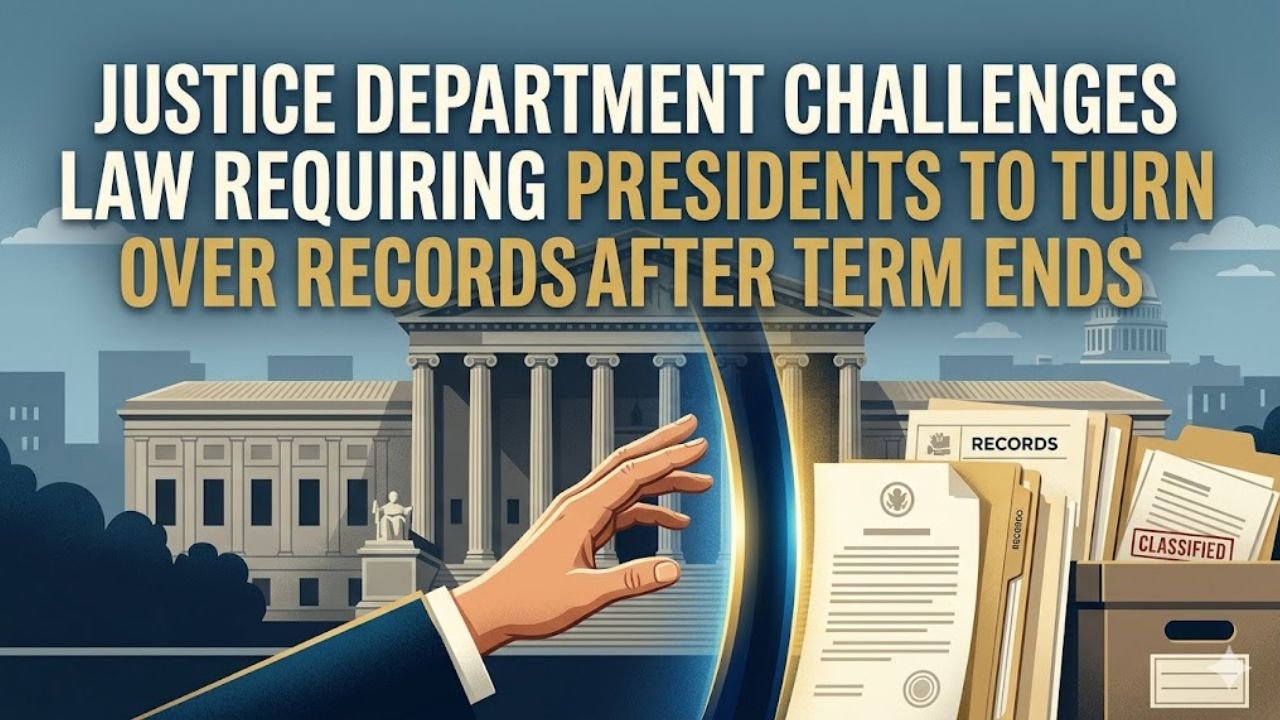
A significant change has happened in how American power is divided among the legislative, judicial, and executive branches, and this is due to a new and questionable action taken by the Department of Justice (DOJ). In April 2026, the DOJ’s Office of Legal Counsel (OLC) issued a memorandum and opinion stating the Presidential Records Act (PRA) of 1978 is unconstitutional. The memorandum stretches 52 pages, and its author, Assistant Attorney General T. Elliot Gaiser, argues that the PRA, which has required the National Archives to hold records that are public and belong to the executive branch, is an unconstitutional infringement on the Executive. In categorizing Presidential records as personal and therefore not public, the DOJ has attacked the Post-Watergate cornerstone of transparency, and this has unleashed a torrent of unprecedented legal and historical controversy.
The Legal Foundation of the Dispute
The most basic element of this case is the separation of power doctrine. The Department of Justice argues that Congress, in enacting the PRA in 1978, overstepped its authority. The OLC’s April 2026 opinion states that the Act “concentrates power in the Legislative Branch” and allows it to control the other branch of government’s internal communications and decision-making. The DOJ’s position is that the President, being a constitutional officer, and the Congress, not being a constitutional body, means that Congress does not have the ‘preservative power’ to possess the private papers of a Chief Executive. This interpretation essentially means that a President’s thoughts, policy discussions, and advisor conversations should be, and in fact, remain, undisclosed outside the President’s private domain, and ultimately in the same state as the records of the pre-Nixon era.
Impact on Historical Preservation and Accountability
For the longest time, the Presidential Records Act was a major plus for the historian and government accountability advocate communities. The PRA provided assurance that the decision-making processes of the most powerful individuals in the most powerful office would be open to the public. Without the PRA, there is always the possibility that important records, be they national security related, policy changes, or anything else, would be kept, and even, destroyed. The American Historical Association and American Oversight have already contested the DOJ memo via lawsuits, arguing that, as a matter of history, the public has the unlimited right to know about its government. The records should be accessible because they are produced using the government’s and the taxpayer’s resources.
Comparison of Presidential Records Act and DOJ 2026 Position
| Feature | Presidential Records Act (1978) | DOJ OLC Opinion (April 2026) |
| Ownership | Public / United States Government | Personal property of the President |
| Legal Custody | Automatically transfers to NARA | Remains with the former President |
| Constitutional Basis | Congressional oversight & preservation | Executive independence (Article II) |
| FOIA Access | Available after 5 to 12 years | Not applicable (private property) |
| Origin | Post-Watergate accountability reform | Recent “Unitary Executive” interpretation |
New Executive Branch Precedent
The timing of this challenge is notable and occurs during sweeping changes and high staff turnover at the Department of Justice. The 2026 opinion has been characterized by critics as a preemptive legal strategy to keep the executive branch decisions free from oversight. OLC opinions are binding on the executive branch but do not carry the force of law in the federal judicial system. It is likely that without a contrary judicial ruling, the current and prior administrations will be able to use this legal opinion to justify the retention of thousands of boxes of records. This is the first time that a sitting administration has been said to challenge the Constitution since the Act has been in place.
What Happens Next for the Courts?
Now that we are in the next phase of the legal fight, we will find out if the DOJ’s July 2021 instructions contradict the previous decisions of the US Supreme Court that deal with legislative and executive branches in a broad sense. Assuming the courts argue in favor of the DOJ, it will affirm that the most breathtaking incursions of United States executive power are yet to come. On the flip side, if the judicial system confirms the principle of the Presidential Records Act (PRA), it will reinforce the fact that the President is bound by the standards of democracy that require accountable record-keeping and socio-political transparency.
What does this mean for the United States?
What is at stake here is the ability of subsequent US governments to decide on the right to access any available limited historical documents that pertain to democracy. If the ability to access documents protected by the Presidential Records Act is permitted, the information is guaranteed to be of an extremely limited nature, with no ability for future generations to validate the condition of United States. The DOJ’s side of the case is that it will protect the President’s ability to receive executive advice and suggestions without the fear of being publicly outed for sharing the information. For many, including the Government, the fear of a repeat of the relationship between the State and society during the dark ages is very real. The 2026 US midterm elections are quickly approaching and the ownership of the White House, and consequently the State’s history, is becoming more and more entrenched in the rule of law.
FAQs
Q1 What was the first goal of the Presidential Records Act?
The PRA was created in 1978 after the Watergate scandal to make sure that public property was recorded on what the president was doing. This acted to protect against the continual Presidential destruction and/or illegal removal of sensitive documents.
Q2 What is new with the 2026 DOJ opinion?
The 2026 opinion says the PRA is unconstitutional and a President’s document is personal property. Because of this, current and former Presidents are legally protected to withhold documents instead of transferring them to the National Archives.
Q3 Can a DOJ memo cancel a law?
Not really. A memo from the Office of Legal Counsel (OLC) is technically supposed to be followed within the executive branch, but striking a law from Congress can only be done by the courts, not a memo. This memo is currently being litigated.